

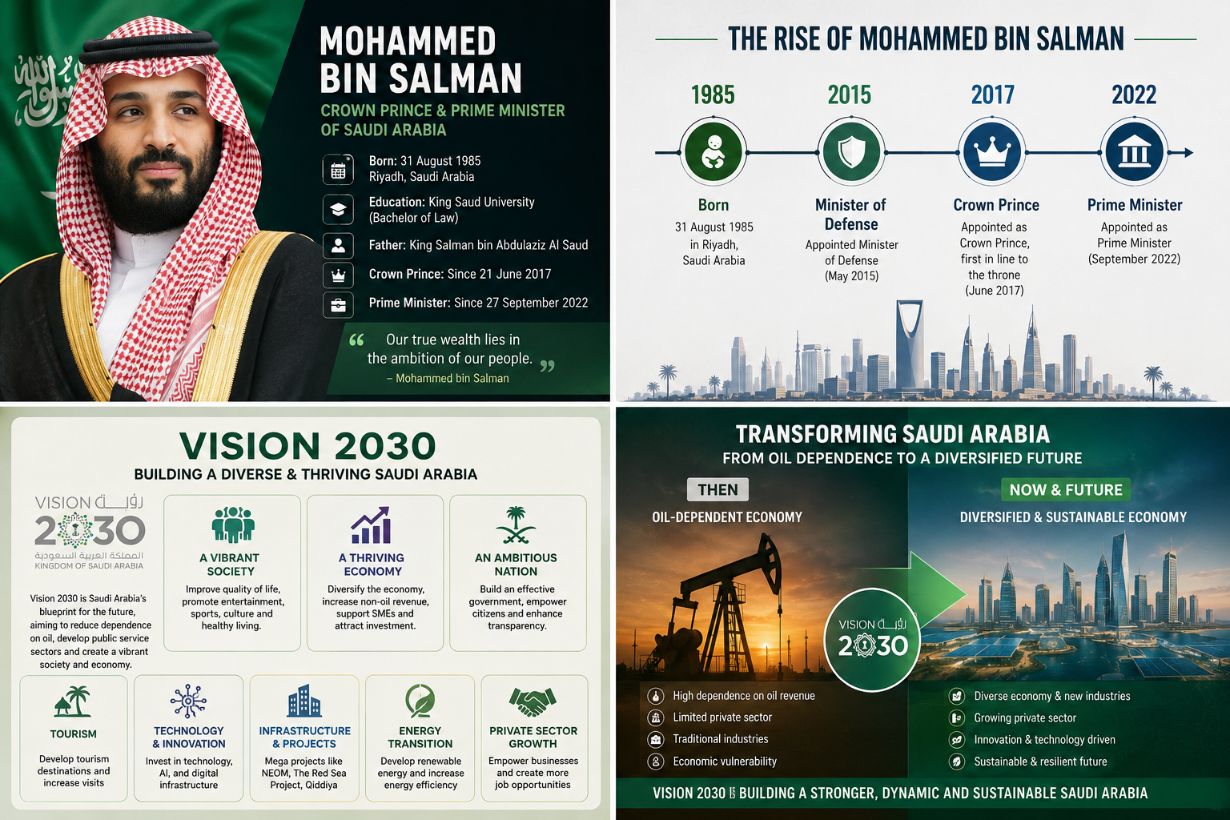
Mohammed bin Salman Al Saud, widely known as MBS, is one of the most influential political figures in the Middle East. As the Crown Prince and Prime Minister of Saudi Arabia, he has become the central figure behind the Kingdom’s economic transformation, social reforms and increasingly assertive foreign policy.
His rise has been remarkably rapid. Born in 1985, Mohammed bin Salman spent his early political career working closely with his father, King Salman bin Abdulaziz Al Saud. After King Salman became monarch in 2015, MBS quickly moved into senior government positions, becoming Minister of Defense and later Crown Prince in 2017. He was appointed Prime Minister in 2022. Saudi Arabia’s Foreign Ministry officially lists him as Crown Prince and Prime Minister.
But understanding Mohammed bin Salman requires looking beyond his titles.
He is the architect and most prominent public face of Saudi Vision 2030, an enormous national transformation programme intended to diversify the Saudi economy, reduce dependence on oil, expand tourism and entertainment, develop new industries, attract investment and reshape Saudi society.
At the same time, his leadership has attracted intense international criticism over human rights, political freedoms and the 2018 killing of journalist Jamal Khashoggi.
The result is a complex picture: MBS is simultaneously viewed as a modernizer, economic reformer, authoritarian ruler, nationalist leader and ambitious geopolitical strategist.
Who Is Mohammed bin Salman?
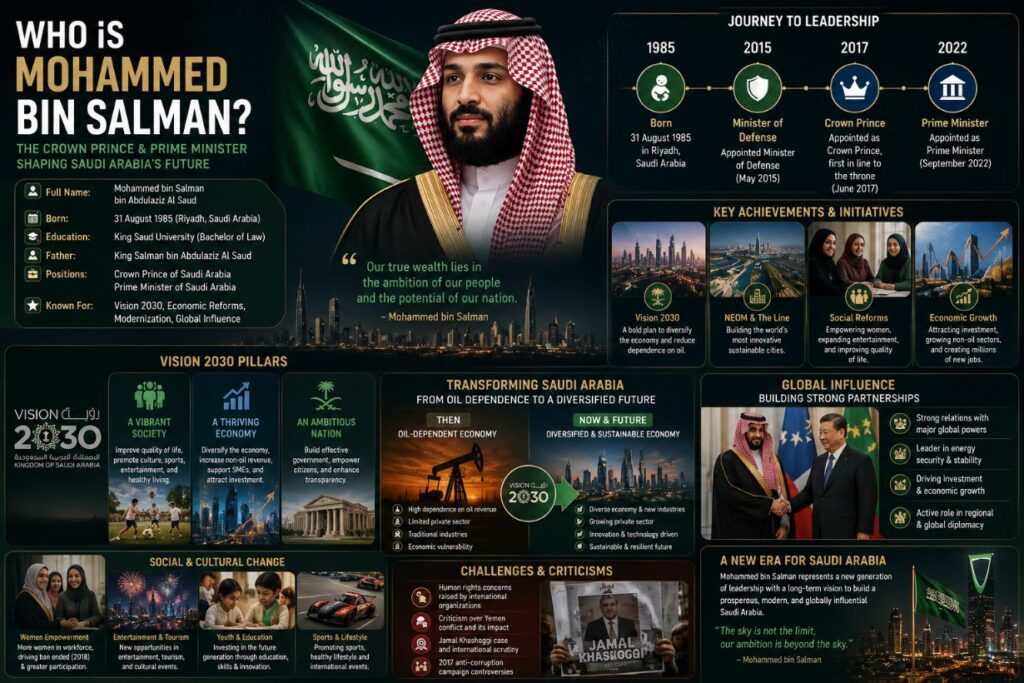
Mohammed bin Salman bin Abdulaziz Al Saud was born on 31 August 1985 in Riyadh, Saudi Arabia. He is the son of King Salman bin Abdulaziz and Princess Fahda bint Falah Al Hithlain.
He belongs to the House of Saud, the ruling royal family of Saudi Arabia.
Unlike some earlier Saudi leaders who spent decades gradually moving through government positions, Mohammed bin Salman rose through the political system at extraordinary speed.
His influence expanded dramatically after his father became king in January 2015.
Today, MBS holds several strategically important positions. He is:
- Crown Prince of Saudi Arabia
- Prime Minister
- Chairman of the Public Investment Fund
- A leading figure in the Kingdom’s economic policymaking
- The principal political force behind Vision 2030
The Public Investment Fund identifies him as Crown Prince, Prime Minister and chairman of the PIF, highlighting the central role he plays in Saudi Arabia’s economic strategy.
Mohammed bin Salman’s Early Life
Mohammed bin Salman was raised in Riyadh within the Saudi royal family.
His childhood was different from that of ordinary Saudi citizens because he grew up close to the country’s political leadership. His father, Salman, served for decades as governor of Riyadh before becoming king.
That experience gave Mohammed bin Salman an early understanding of government, administration and Saudi politics.
He studied law at King Saud University and graduated with a bachelor’s degree.
Before becoming a national political figure, he worked in the private sector and established charitable and business-related initiatives. He later became an adviser to his father when Salman was governor of Riyadh.
This relationship became increasingly important as Salman moved closer to the center of Saudi political power.
Mohammed bin Salman and King Salman
The relationship between Mohammed bin Salman and his father has played a major role in his rise.
When King Salman became monarch in 2015, Mohammed bin Salman was appointed Minister of Defense at a relatively young age.
He was also appointed chairman of the Council of Economic and Development Affairs, giving him enormous influence over economic policy.
His responsibilities went far beyond the defense ministry.
He became increasingly involved in:
- Economic planning
- Government restructuring
- Investment
- Energy policy
- National development
- Foreign relations
- Security affairs
This concentration of responsibilities helped transform him from a young royal into Saudi Arabia’s most powerful policymaker.
The Rise of Mohammed bin Salman
MBS became Deputy Crown Prince in 2015.
Two years later, in June 2017, King Salman appointed him Crown Prince, replacing Mohammed bin Nayef.
The appointment represented a major generational shift in Saudi leadership.
For decades, Saudi Arabia’s leadership had largely moved among sons of the Kingdom’s founder, Abdulaziz Ibn Saud. Mohammed bin Salman represented a younger generation.
His appointment therefore had significance beyond one individual.
It suggested that Saudi Arabia was preparing for a new political era.
Mohammed bin Salman Becomes Prime Minister
In September 2022, King Salman appointed Mohammed bin Salman as Prime Minister of Saudi Arabia.
The move formalized his already dominant role in government.
Although King Salman remained monarch, MBS became the central executive figure responsible for much of the Kingdom’s domestic and international agenda.
His political authority is closely connected with the country’s long-term transformation strategy.
What Is Saudi Vision 2030?
Perhaps Mohammed bin Salman’s most important initiative is Saudi Vision 2030.
Launched in 2016, Vision 2030 is Saudi Arabia’s long-term economic and social transformation strategy.
Its central objective is straightforward:
Make Saudi Arabia less dependent on oil and build a more diversified, competitive and globally connected economy.
The programme is structured around three broad pillars:
1. A Vibrant Society
This focuses on:
- Culture
- Entertainment
- Sports
- Tourism
- Quality of life
- Healthcare
- Community development
2. A Thriving Economy
This includes:
- Economic diversification
- Private-sector growth
- Foreign investment
- Technology
- Tourism
- Manufacturing
- New industries
3. An Ambitious Nation
This focuses on:
- Government efficiency
- Public-sector reform
- Accountability
- Digital government
- Institutional development
Saudi government sources describe Vision 2030 as the Kingdom’s roadmap for economic development and national transformation.
Read Also: What Is Saudi Vision 2030? How Saudi Arabia Is Transforming Its Future
Why Does Saudi Arabia Want to Reduce Its Dependence on Oil?
For decades, oil has been the foundation of Saudi Arabia’s economy.
The Kingdom possesses some of the world’s largest petroleum reserves and has traditionally relied heavily on oil exports to generate government revenue.
But oil prices can fluctuate dramatically.
Saudi policymakers therefore recognized that relying overwhelmingly on hydrocarbons could create long-term economic risks.
MBS has repeatedly promoted the idea that Saudi Arabia needs to prepare for a future in which economic growth comes from many different sectors.
Vision 2030 therefore seeks to develop:
- Tourism
- Technology
- Manufacturing
- Mining
- Logistics
- Entertainment
- Sports
- Renewable energy
- Financial services
- Artificial intelligence
- Digital industries
The goal is not simply to stop producing oil.
Instead, Saudi Arabia wants oil to remain an important source of wealth while building additional economic engines.
The Public Investment Fund
One of the most powerful tools behind MBS’s economic strategy is the Public Investment Fund (PIF).
The PIF is Saudi Arabia’s sovereign wealth fund and has become one of the most important investment institutions in the world.
Under Mohammed bin Salman, the fund has expanded dramatically.
It invests in Saudi and international companies and finances major domestic development projects.
Its portfolio and strategy cover areas including:
- Technology
- Gaming
- Sports
- Tourism
- Real estate
- Aviation
- Automotive
- Entertainment
- Renewable energy
- Artificial intelligence
MBS’s position as chairman of the PIF makes the fund a major instrument of Vision 2030.
NEOM: Mohammed bin Salman’s Most Ambitious Project
Few projects represent Mohammed bin Salman’s ambitions better than NEOM.
NEOM is planned as a massive futuristic development in northwestern Saudi Arabia.
Its projects include concepts such as:
- The Line
- Oxagon
- Trojena
- Sindalah
The original vision presented NEOM as a futuristic economic region powered by advanced technology, clean energy and innovative urban design.
The Line, in particular, attracted global attention because of its proposed linear city design.
However, by 2026, Saudi Arabia has increasingly focused on prioritizing projects, controlling costs and developing major schemes in phases.
Recent reporting indicates that the PIF has been reassessing several mega-projects, with greater emphasis on commercially viable and phased development.
This illustrates an important evolution in Vision 2030: the Kingdom is moving from announcing extremely ambitious projects toward determining which projects can deliver the greatest economic return.
Saudi Arabia’s Tourism Transformation
Tourism is another major part of MBS’s economic strategy.
For decades, Saudi Arabia’s international tourism industry was limited largely to religious visitors traveling to Makkah and Madinah.
The Kingdom changed dramatically after it began opening itself to international tourists.
Saudi Arabia introduced tourist visas and began promoting destinations across the country.
The government has invested heavily in:
- Hotels
- Resorts
- Cultural attractions
- Heritage sites
- Entertainment
- Airports
- Tourism infrastructure
The objective is to make Saudi Arabia one of the world’s major tourism destinations.
Entertainment Revolution Under MBS
One of the most visible changes in Saudi society has been the rapid expansion of entertainment.
Saudi Arabia now hosts:
- Concerts
- International sporting events
- Film events
- Festivals
- Comedy shows
- Cultural events
- Gaming competitions
The Kingdom established the General Entertainment Authority, which has played a major role in developing the entertainment industry.
Events such as Riyadh Season have attracted international celebrities, athletes and entertainers.
For many young Saudis, this represents a dramatic change from the social environment that existed only a decade ago.
Women’s Rights and Social Reforms
Mohammed bin Salman’s government has overseen several major social reforms.
One of the most internationally visible changes was the end of the prohibition on women driving in 2018.
Saudi women have also gained greater access to:
- Employment
- Education
- Sports
- Public entertainment
- Business opportunities
- Travel and mobility
The government has also reduced some restrictions associated with the traditional male-guardianship system.
These changes have significantly altered Saudi society.
However, the reforms exist alongside criticism from international human-rights organizations regarding political freedoms and the treatment of activists.
That contradiction is central to understanding MBS’s leadership.
Mohammed bin Salman and Saudi Youth
Saudi Arabia has a very young population.
This demographic reality is extremely important for Vision 2030.
MBS has positioned his reforms around creating opportunities for a generation that wants:
- Jobs
- Entertainment
- Technology
- Travel
- Education
- Entrepreneurship
- International connections
The transformation is therefore not only economic.
It is also an attempt to reshape the social contract between the Saudi government and its younger population.
Sports as a Tool of Saudi Strategy
Sports have become another major pillar of Saudi Arabia’s global strategy.
The Kingdom has invested heavily in:
- Football
- Golf
- Boxing
- Formula 1
- Horse racing
- Esports
- Major international sporting events
Saudi Arabia’s football clubs have attracted some of the world’s most famous players.
The country has also used sports to strengthen its international profile and promote tourism and investment.
Critics sometimes describe this strategy as “sportswashing,” arguing that Saudi Arabia uses high-profile sporting events to improve its global image despite human-rights concerns.
Saudi officials and supporters, however, describe sports investment as part of economic diversification and youth development.
Mohammed bin Salman and the Global Economy
MBS has attempted to transform Saudi Arabia from an oil exporter into a global investment power.
Saudi investments increasingly reach beyond the Middle East.
The PIF has invested internationally in areas including:
- Technology
- Gaming
- Sports
- Entertainment
- Automotive companies
- Financial institutions
The strategy is designed to generate returns while building expertise that can eventually benefit the Saudi economy.
Mohammed bin Salman and the United States
The United States remains one of Saudi Arabia’s most important strategic partners.
The relationship includes:
- Defense
- Energy
- Investment
- Technology
- Intelligence
- Regional security
However, the relationship has also experienced periods of tension.
Washington has criticized Saudi Arabia over human rights and the Khashoggi case, while Riyadh has increasingly emphasized that it wants an independent foreign policy rather than relying exclusively on Washington.
Saudi Arabia’s Growing Relationship With China
China has become increasingly important to Saudi Arabia.
Economic relations between the two countries have expanded rapidly.
China is important to Saudi Arabia as:
- A major trading partner
- An energy customer
- A technology partner
- An infrastructure partner
- A diplomatic partner
MBS has therefore pursued a foreign policy that seeks strong relationships with multiple major powers rather than depending entirely on one.
Saudi Arabia, Russia and OPEC+
Energy policy has also brought Saudi Arabia closer to Russia.
Saudi Arabia and Russia have worked together within OPEC+, the broader oil-production coordination framework.
The relationship has sometimes frustrated Washington because production decisions can affect global oil prices.
For Riyadh, however, cooperation with Moscow serves an important economic purpose: protecting Saudi Arabia’s interests in global energy markets.
Read Also: What Is OPEC and Why Is It Important? A Complete Beginner’s Guide
Mohammed bin Salman and Iran
Saudi Arabia and Iran have historically been regional rivals.
The rivalry has involved disputes over:
- Regional influence
- Yemen
- Syria
- Iraq
- Lebanon
- Gulf security
But MBS’s foreign policy has also included attempts to reduce tensions.
Saudi Arabia and Iran agreed in 2023 to restore diplomatic relations following Chinese mediation.
The development demonstrated that MBS’s foreign policy is not simply based on confrontation.
Saudi Arabia has increasingly sought diplomatic channels alongside deterrence and military preparedness.
Mohammed bin Salman and Pakistan
Pakistan has a particularly important relationship with Saudi Arabia.
The two countries have longstanding connections involving:
- Defense
- Religion
- Trade
- Investment
- Labor
- Diplomacy
The relationship gained additional strategic importance with the Saudi Arabia–Pakistan mutual defense agreement signed in 2025, followed by the broader Mecca Joint Defence Agreement involving Saudi Arabia, Pakistan and Türkiye in August 2026. Reuters reported that the 2026 agreement establishes a collective-defense principle under which an armed attack against one member is considered an attack against all.
For MBS, deeper relations with Pakistan provide an important security partnership with one of the world’s major military powers.
For Pakistan, Saudi Arabia remains an important economic and strategic partner.
The 2026 Saudi-Türkiye-Pakistan Defence Pact
A particularly significant recent development came in August 2026.
Saudi Arabia, Pakistan and Türkiye signed the Mecca Joint Defence Agreement.
The agreement aims to strengthen military and strategic cooperation between the three countries.
According to Reuters, Turkish Foreign Minister Hakan Fidan said the arrangement is technically comparable to NATO’s Article 5 collective-defense principle, while emphasizing that it was not directed against Iran.
The agreement potentially represents a significant development in regional security architecture.
For Mohammed bin Salman, it demonstrates Saudi Arabia’s desire to strengthen partnerships beyond its traditional dependence on Western security guarantees.
Mohammed bin Salman and Yemen
One of the most controversial aspects of MBS’s foreign policy has been Saudi Arabia’s involvement in Yemen.
Saudi Arabia launched a military intervention in Yemen in 2015 against the Houthi movement after the Houthis took control of large parts of the country.
The conflict produced a severe humanitarian crisis and became one of the most difficult challenges facing Saudi foreign policy.
MBS has subsequently supported diplomatic efforts and negotiations aimed at reducing the conflict.
Yet Yemen remains a major security concern for Saudi Arabia because of missile and drone attacks against Saudi territory and threats to Red Sea shipping.
Human Rights Controversies
Mohammed bin Salman’s international reputation cannot be understood without discussing human rights.
Supporters point to major social reforms and economic modernization.
Critics point to:
- Restrictions on political opposition
- Detention of activists
- Restrictions on freedom of expression
- Treatment of dissidents
- Capital punishment
- Alleged abuses against critics
This creates one of the biggest contradictions surrounding his leadership.
Saudi Arabia has become more socially open in several areas while remaining highly restrictive in political life.
Mohammed bin Salman: Reformer or Authoritarian Leader?
There is no simple answer.
Supporters argue that MBS has transformed Saudi Arabia faster than any previous Saudi leader in modern history.
They point to:
- Women’s increased participation in society
- Entertainment
- Tourism
- Economic diversification
- Technology
- Foreign investment
- Infrastructure
- Youth opportunities
Critics argue that these reforms have occurred alongside a concentration of political power and restrictions on dissent.
Both aspects are important when evaluating his leadership.
Mohammed bin Salman’s Leadership Style
MBS represents a significant departure from the traditional image of Saudi leadership.
He is young, highly visible and heavily involved in economic policy.
His leadership style is characterized by:
Centralization: Major economic and political initiatives are closely connected to his leadership.
Speed: Reforms and projects have often been introduced rapidly.
Ambition: Vision 2030 includes goals that would fundamentally change Saudi Arabia’s economic structure.
Nationalism: MBS emphasizes Saudi national identity and national interests.
Globalization: Saudi Arabia increasingly seeks partnerships with countries across Asia, Europe and the Americas.
Pragmatism: Riyadh has shown willingness to work simultaneously with Washington, Beijing, Moscow and regional rivals when it considers this beneficial.
What Has Mohammed bin Salman Changed in Saudi Arabia?
The scale of change since 2015 is difficult to ignore.
Saudi Arabia today looks significantly different from the country of a decade ago.
Some of the most visible changes include:
- Women driving
- Greater female participation in the workforce
- International tourism
- Large entertainment events
- International sporting competitions
- New tourism destinations
- Rapid infrastructure development
- Greater foreign investment
- Expansion of technology industries
- More cultural events
- Growing global visibility
The transformation is still underway.
Challenges Facing Mohammed bin Salman
Despite the progress claimed by Vision 2030, MBS faces serious challenges.
Oil Dependence
Saudi Arabia still depends heavily on hydrocarbons.
Diversifying an economy as large as Saudi Arabia’s takes decades.
Mega-Project Costs
Some Vision 2030 projects require enormous amounts of capital.
The recent reassessment of several PIF projects demonstrates the challenge of balancing ambition with financial sustainability.
Employment
Creating enough productive private-sector jobs for Saudi citizens remains essential.
Regional Conflicts
Saudi Arabia operates in one of the world’s most unstable regions.
Iran, Yemen, Israel-Palestine, Red Sea security and Gulf tensions all affect Riyadh’s strategic calculations.
International Reputation
Human-rights criticism continues to affect Saudi Arabia’s relationship with Western governments and international organizations.
What Could Saudi Arabia Look Like in 2030?
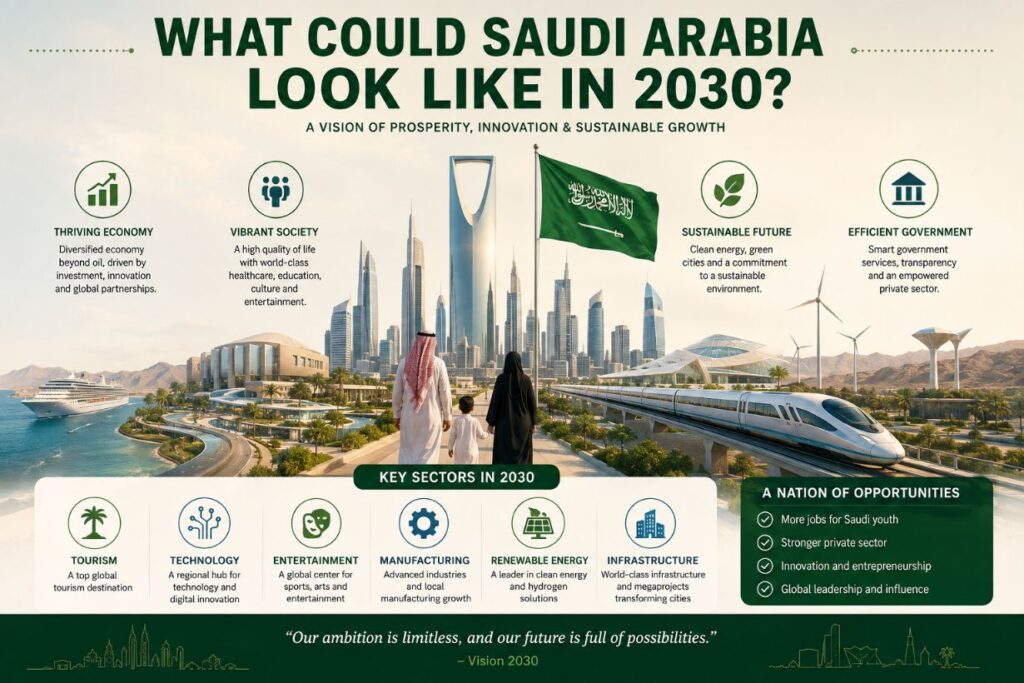
The answer will depend heavily on how successfully Vision 2030 progresses.
If the strategy succeeds, Saudi Arabia could become:
- A major global tourism destination
- A regional technology hub
- A major investment center
- A leading sports market
- A logistics hub between Asia, Europe and Africa
- A diversified Middle Eastern economy
But success will not necessarily mean that Saudi Arabia stops being an oil superpower.
A more realistic outcome could be a Saudi Arabia that remains one of the world’s largest energy producers while simultaneously becoming a major player in technology, tourism, finance, logistics and entertainment.
Mohammed bin Salman: Frequently Asked Questions
How old is Mohammed bin Salman?
Mohammed bin Salman was born on 31 August 1985.
What is Mohammed bin Salman’s position?
He is the Crown Prince and Prime Minister of Saudi Arabia.
Who is Mohammed bin Salman’s father?
His father is King Salman bin Abdulaziz Al Saud, the King of Saudi Arabia.
What is Mohammed bin Salman famous for?
He is best known internationally for leading Saudi Vision 2030, Saudi Arabia’s economic and social transformation programme.
What is Vision 2030?
Vision 2030 is Saudi Arabia’s long-term strategy to diversify its economy, develop new industries, improve quality of life and reduce dependence on oil.
What is NEOM?
NEOM is a large-scale development project in northwestern Saudi Arabia designed around futuristic cities, tourism, technology and advanced infrastructure.
Is Mohammed bin Salman the King of Saudi Arabia?
No. As of August 2026, King Salman remains the King, while Mohammed bin Salman is Crown Prince and Prime Minister.
What happened to Jamal Khashoggi?
Jamal Khashoggi was killed inside the Saudi consulate in Istanbul in October 2018. The case resulted in international condemnation and remains one of the biggest controversies surrounding MBS.
Does Mohammed bin Salman support economic diversification?
Yes. Economic diversification is one of the central objectives of Vision 2030.
What is Mohammed bin Salman’s role in the Public Investment Fund?
He is chairman of the PIF, which plays a central role in financing and implementing many of Saudi Arabia’s major economic projects.
Conclusion
Mohammed bin Salman is one of the most consequential leaders of the modern Middle East.
His rise from a relatively unknown young Saudi prince to Crown Prince and Prime Minister has been exceptionally rapid. Since entering the center of power, he has pursued an ambitious programme designed to transform Saudi Arabia economically, socially and internationally.
His Vision 2030 has opened new sectors, expanded tourism and entertainment, increased women’s participation in society and attracted enormous investment into new industries.
At the same time, his government has faced serious criticism over political freedoms, human rights and the Khashoggi case.
His foreign policy has also evolved. Saudi Arabia has maintained its strategic relationship with the United States while deepening ties with China, Russia, Pakistan, Türkiye and other countries. The 2026 defense agreement with Pakistan and Türkiye is another indication that Riyadh is seeking a stronger and more diversified strategic position.
The biggest test for Mohammed bin Salman now is execution.
Saudi Arabia has announced some of the world’s most ambitious economic and urban-development projects. The coming years will show which projects become sustainable successes and which are scaled back or redesigned.
If Vision 2030 succeeds, MBS could leave behind a Saudi Arabia that is substantially different from the Kingdom he inherited.
If it falls short, the enormous cost and scale of the transformation could become one of the defining criticisms of his rule.
Either way, Mohammed bin Salman has already changed the trajectory of Saudi Arabia—and his influence is likely to shape the Kingdom and the wider Middle East for many years to come.