


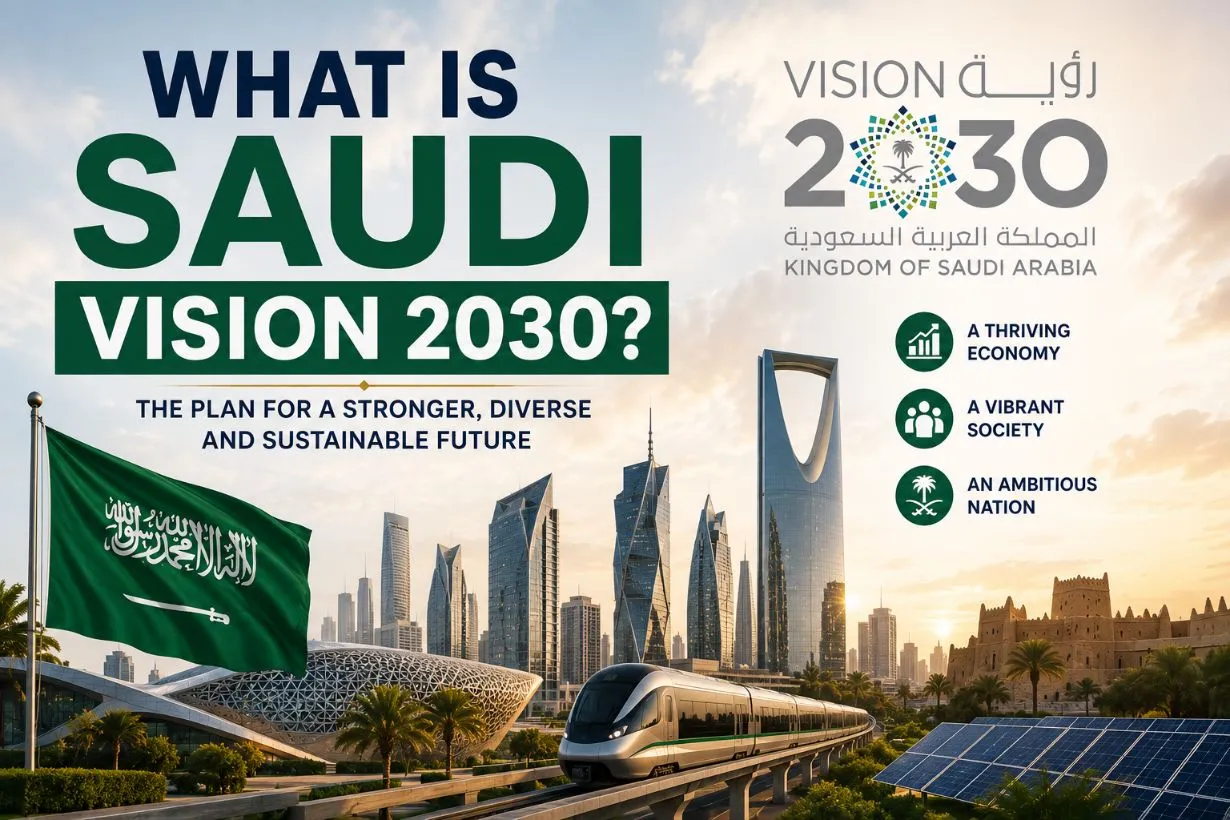
Saudi Vision 2030 is a long-term national development plan designed to transform Saudi Arabia’s economy and society.
Launched in 2016, the vision aims to build a more diversified economy, improve quality of life, develop new industries and create more opportunities for Saudi citizens.
For decades, oil has been at the center of Saudi Arabia’s economy. The country remains one of the world’s most important energy producers, but Vision 2030 recognizes that the future economy can be broader than petroleum alone.
The plan therefore focuses on areas such as tourism, technology, manufacturing, mining, logistics, entertainment, culture, renewable energy and private-sector investment.
Official Vision 2030 material describes the transformation around three broad themes: a vibrant society, a thriving economy and an ambitious nation.
The Three Main Pillars of Saudi Vision 2030
Vision 2030 is built around three major themes.
1. A Vibrant Society
The first pillar focuses on improving the quality of life in Saudi Arabia.
This includes areas such as:
- Culture and heritage
- Sports
- Entertainment
- Healthcare
- Housing
- Tourism
- Community development
- Environmental protection
The idea is to create communities where people can enjoy a wider range of cultural, recreational and social opportunities.
Saudi Arabia has therefore invested heavily in museums, cultural destinations, sports events, entertainment venues, tourism infrastructure and historic areas.
2. A Thriving Economy
The second pillar focuses on economic growth and diversification.
Saudi Arabia wants to create an environment where businesses can grow and where private-sector investment plays a larger role in the economy.
Major areas include:
- Tourism
- Manufacturing
- Mining
- Logistics
- Technology
- Financial services
- Renewable energy
- Entrepreneurship
- Digital transformation
The official Vision 2030 program currently lists initiatives covering financial-sector development, industrial and logistics development, human capability, privatization, fiscal sustainability and national transformation.
3. An Ambitious Nation
The third pillar focuses on improving government performance, efficiency and accountability.
The objective is to build government systems that can respond more effectively to the country’s changing needs.
Digital government services, institutional development, transparency and more efficient public administration are important parts of this effort.
How Saudi Arabia Is Diversifying Its Economy
Economic diversification is one of the most important parts of Vision 2030.
Instead of depending mainly on oil-related activity, Saudi Arabia is developing several new economic sectors.
Tourism
Tourism has become one of the biggest areas of focus.
Saudi Arabia has opened more destinations to international visitors and is developing cultural, historical, coastal and entertainment attractions.
Projects and destinations connected with AlUla, the Red Sea, Diriyah and other regions are part of this wider transformation. The official Vision 2030 platform currently lists tourism-related developments alongside major projects such as Qiddiya, NEOM, ROSHN and Diriyah.
Saudi Arabia’s Mega Projects
Perhaps the most visible part of Vision 2030 is the country’s collection of large-scale development projects.
These projects are designed not only to create new destinations but also to support tourism, technology, real estate, entertainment, logistics and investment.
NEOM
NEOM is one of the most internationally recognized Vision 2030 projects.
It is being developed in northwestern Saudi Arabia and includes several planned developments focused on technology, tourism, sustainability and new forms of urban development.
NEOM has attracted global attention because of the scale and ambition of its plans.
The Red Sea
The Red Sea project focuses on luxury tourism and coastal development.
The area is being developed around natural landscapes, islands and marine environments, with sustainability positioned as an important part of the concept.
Qiddiya
Qiddiya is designed as a major entertainment, sports and cultural destination.
The project reflects Saudi Arabia’s effort to create more recreational opportunities while developing new economic sectors around sports, entertainment and tourism.
Diriyah
Diriyah is particularly important because of its historical and cultural significance.
The development aims to transform the historic area into a major cultural and tourism destination while preserving its heritage.
The Vision 2030 platform identifies Diriyah among its major Vision 2030 projects.
Why Is Saudi Arabia Moving Beyond Oil?
Oil has played a huge role in Saudi Arabia’s economic development. However, relying heavily on a single major commodity can expose an economy to changes in global prices and demand.
Oil markets can be affected by economic slowdowns, geopolitical events, technological changes and the global transition toward alternative energy.
Saudi Arabia’s diversification strategy is therefore about creating additional sources of economic activity rather than simply abandoning oil.
The goal is to develop industries that can create jobs, attract investment and generate economic value over the long term.
This includes tourism, mining, logistics, manufacturing, digital services, entertainment and other emerging sectors.
Read Also: What Is OPEC and Why Is It Important?
How Saudi Arabia Is Developing Tourism
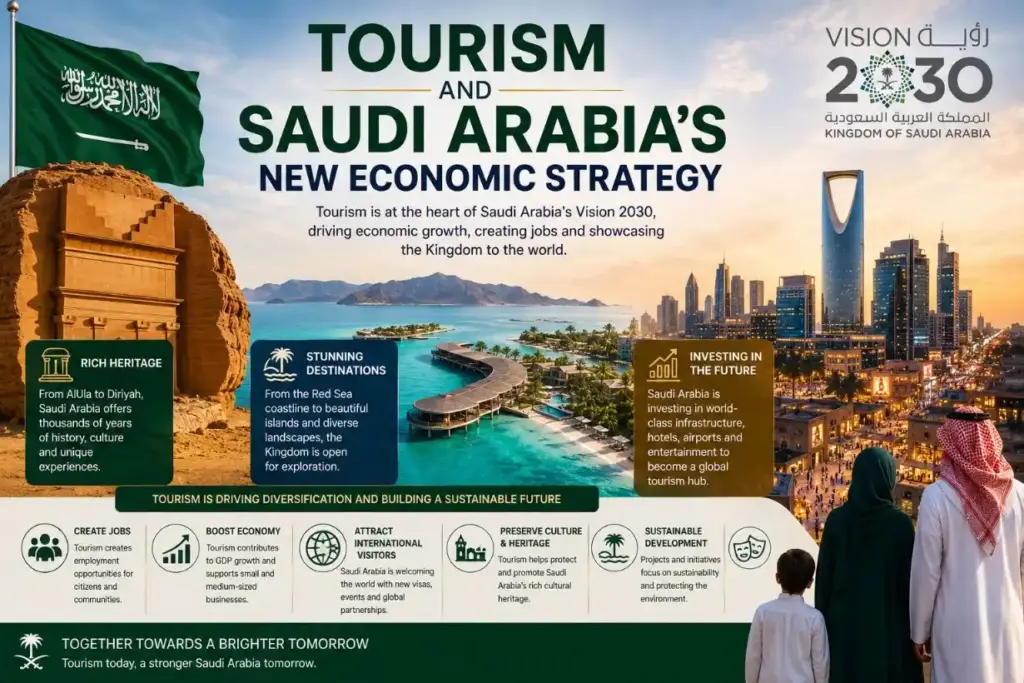
Saudi Arabia has enormous tourism potential because of its history, geography, religious significance and cultural heritage.
The Kingdom is home to important Islamic sites in Makkah and Madinah, ancient archaeological areas, desert landscapes, Red Sea coastlines and historic cities.
Vision 2030 is encouraging the development of these resources into a broader tourism economy.
Saudi Arabia is also investing in:
- Hotels and resorts
- Airports
- Transportation
- Cultural attractions
- Entertainment
- Heritage sites
- Tourism services
- Digital travel platforms
The long-term objective is to make tourism an important contributor to the national economy.
Saudi Arabia and Technology
Technology is another important part of the country’s transformation.
Saudi Arabia is investing in digital infrastructure, artificial intelligence, cloud computing, smart cities and other emerging technologies.
The country sees technology not simply as a support service but as an economic sector capable of creating new businesses and highly skilled jobs.
Digital transformation is also changing how citizens and residents interact with government services.
Renewable Energy and Sustainability
Although Saudi Arabia is famous for oil, it is also investing in renewable energy.
Solar power has particular potential because of the country’s large land area and high levels of sunlight.
Vision 2030 includes environmental and sustainability initiatives alongside broader economic development.
Projects such as the Saudi Green Initiative and renewable-energy developments form part of the Kingdom’s wider effort to address environmental challenges.
The current Vision 2030 project listings include solar-energy developments and the Saudi Green Initiative.
Mining: Another Important Part of Saudi Arabia’s Future
Saudi Arabia is also looking beyond oil and gas toward its mineral resources.
The country has deposits of various minerals and metals that could support manufacturing and industrial development.
Mining can become important for several reasons:
- It can attract foreign investment.
- It can support local industries.
- It can create skilled jobs.
- It can strengthen supply chains.
- It can provide another source of export revenue.
The official Vision 2030 program identifies mining and industrial development among the sectors being developed as part of economic diversification.
What Does Vision 2030 Mean for Young Saudis?
One of the most important questions is how this transformation will affect younger generations.
Saudi Arabia has a relatively young population, making education, skills and employment major priorities.
A more diversified economy can create opportunities in sectors that were previously much smaller or less developed.
These include:
- Technology
- Tourism
- Healthcare
- Engineering
- Finance
- Entertainment
- Sports
- Digital services
- Renewable energy
- Manufacturing
The Vision 2030 framework includes human-capability development as one of its major programs.
The Role of Women in Saudi Arabia’s Economic Transformation
Women’s participation in the workforce has become another visible part of Saudi Arabia’s social and economic changes.
As new industries develop, more opportunities are emerging across education, business, technology, tourism, healthcare and other sectors.
This matters economically because increasing participation in the workforce can expand the country’s pool of talent and contribute to household and national income.
How Vision 2030 Could Change Riyadh
Riyadh is at the center of many of Saudi Arabia’s economic and urban development plans.
The capital is becoming an increasingly important destination for business, technology, entertainment, sports and international investment.
Major urban projects are intended to improve transportation, public spaces, housing and quality of life.
Projects such as Green Riyadh and Riyadh Art are among the developments listed on the official Vision 2030 platform.
Why Saudi Arabia’s Location Matters
Saudi Arabia occupies a strategically important position between Asia, Africa and Europe.
This location gives the Kingdom an advantage in:
- International trade
- Logistics
- Shipping
- Aviation
- Tourism
- Investment
The country’s development plans therefore include logistics and transportation as important parts of its future economy.
Saudi Arabia’s location also places it close to some of the world’s most important energy and maritime routes.
Read Also: What Is the Strait of Hormuz and Why Is It Important to the World?
What Are the Biggest Challenges for Vision 2030?
Transforming an economy as large as Saudi Arabia’s is not simple.
Several challenges could influence the pace and success of the transformation.
Managing Costs
Large infrastructure projects require significant investment and careful long-term planning.
Global Economic Conditions
Changes in global growth, interest rates, commodity prices and investment conditions can affect development.
Building Skilled Talent
New industries require workers with specialized technical and professional skills.
Balancing Growth and Sustainability
Large-scale development must also consider water, energy, environmental protection and natural ecosystems.
Delivering Projects Over the Long Term
Some Vision 2030 projects are extremely ambitious and require years of planning, construction and investment.
What Could Saudi Arabia Look Like by 2030?
It is impossible to know exactly what Saudi Arabia will look like in 2030.
However, the direction of the country’s strategy is clear.
Saudi Arabia is working toward an economy where oil remains important but is supported by a much wider range of industries.
Tourism, technology, mining, manufacturing, logistics, entertainment, finance and renewable energy are expected to play increasingly important roles.
The country’s official 2025 Vision 2030 report describes the current phase as one focused on advancing national and sectoral strategies and sustaining progress across areas including tourism, culture, renewable energy and mining.
Why Saudi Vision 2030 Matters to the World
Saudi Arabia’s transformation is not only a domestic story.
The Kingdom is one of the world’s most important energy producers and a major economy in the Middle East.
Changes in Saudi Arabia can therefore affect international energy markets, investment, tourism, trade and regional development.
If diversification succeeds, Saudi Arabia could become less dependent on oil revenues while developing new industries capable of competing globally.
That would represent a major change for both the Kingdom and the wider Middle East.
Saudi Vision 2030 Frequently Asked Questions
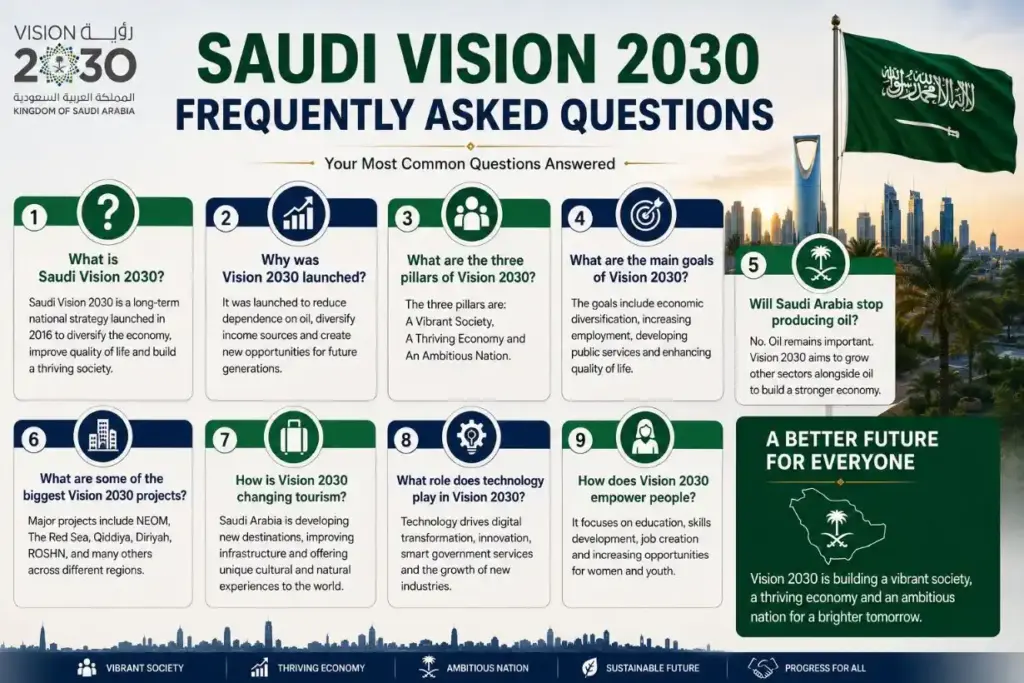
What is Saudi Vision 2030?
Saudi Vision 2030 is a long-term national development strategy launched in 2016 to diversify Saudi Arabia’s economy, improve quality of life and develop new social and economic opportunities.
Why did Saudi Arabia launch Vision 2030?
The strategy was launched to reduce the economy’s dependence on oil and develop additional sectors such as tourism, technology, mining, manufacturing, logistics and entertainment.
What are the three pillars of Vision 2030?
The three main themes are A Vibrant Society, A Thriving Economy and An Ambitious Nation.
What are the biggest Vision 2030 projects?
Major projects include NEOM, Qiddiya, the Red Sea, Diriyah and ROSHN, alongside many other national and regional developments.
Is Saudi Arabia trying to stop producing oil?
No. Vision 2030 is better understood as an economic diversification strategy. Oil remains important, while Saudi Arabia is simultaneously developing additional sources of economic activity.
How is Vision 2030 changing tourism?
Saudi Arabia is developing cultural, historical, coastal and entertainment destinations while expanding tourism infrastructure and services.
What role does technology play in Vision 2030?
Technology supports digital government, new businesses, smart infrastructure, artificial intelligence and other emerging industries.
Will Vision 2030 create jobs?
One of its goals is to create more opportunities for Saudi citizens by expanding the private sector and developing new industries and skills.
When will Vision 2030 be completed?
The target year is 2030, but many of the economic, infrastructure and social changes associated with the strategy are designed to continue beyond that date.
Conclusion
Saudi Vision 2030 represents one of the most ambitious economic and social transformation programs in the modern Middle East.
The strategy is not simply about building futuristic cities or attracting tourists. At its heart, it is about preparing Saudi Arabia for a future in which economic opportunities come from many different sectors.
Oil will remain an important part of the Kingdom’s economy, but tourism, technology, mining, manufacturing, logistics, entertainment and renewable energy are becoming increasingly important.
From NEOM and the Red Sea to Diriyah, Qiddiya and Riyadh’s urban development, the transformation is already visible across the country.
The real measure of Vision 2030, however, will not only be the size of its projects. It will be whether the strategy creates a sustainable, diversified economy and lasting opportunities for future generations.
For Saudi Arabia, 2030 is therefore not simply a deadline. It is a long-term attempt to reshape what the Kingdom’s economy and society can look like in the decades ahead.

[…] Read Also: What Is Saudi Vision 2030? How Saudi Arabia Is Transforming Its Future […]
[…] Read Also: What Is Saudi Vision 2030? How Saudi Arabia Is Transforming Its Future […]