

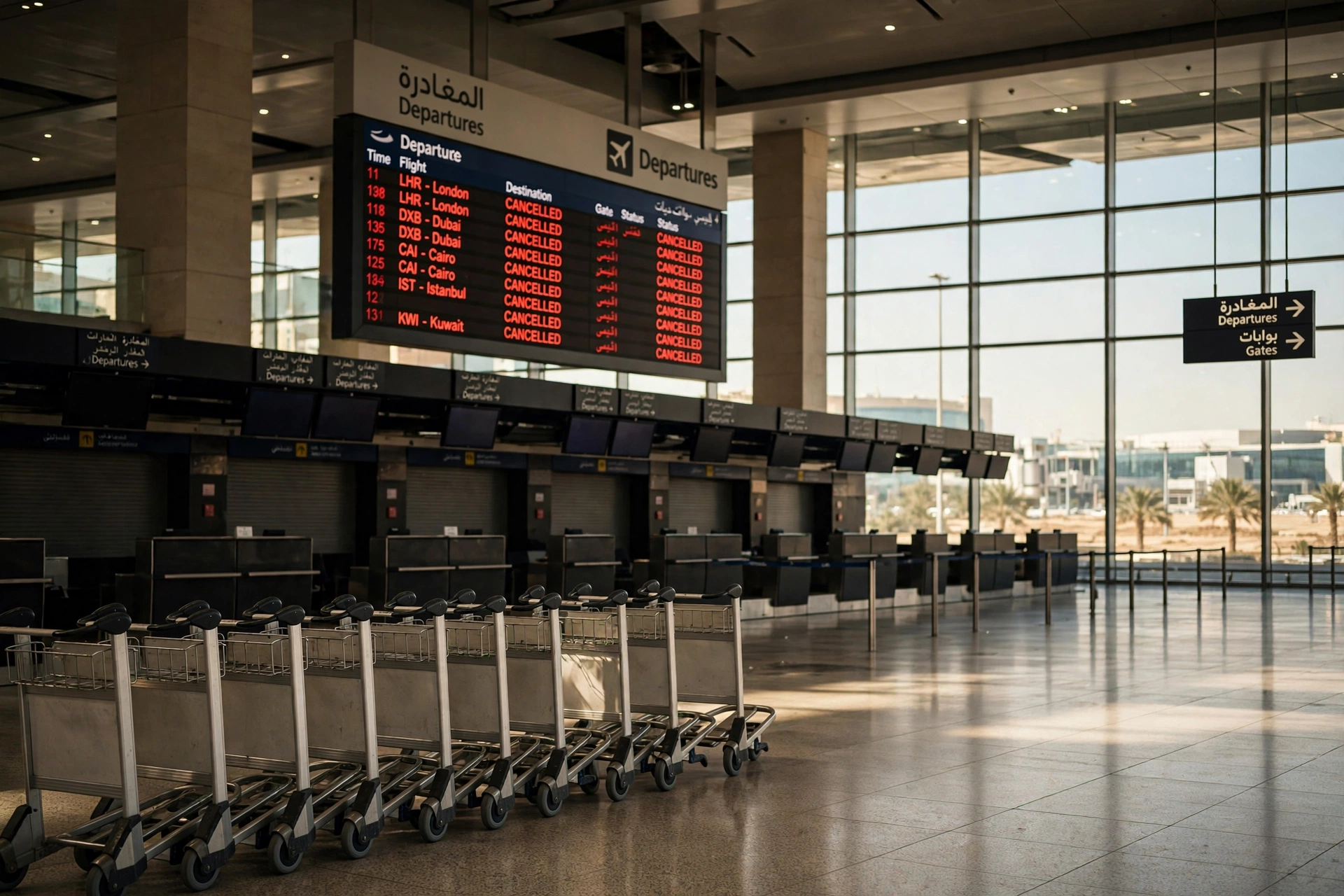
RIYADH, October 14, 2026 — More than 3,100 flights to and from Saudi Arabia have been cancelled in the past week, aviation data shows, as a wave of Houthi attacks on the kingdom’s airports keeps Riyadh’s main international hub shut and pushes global airlines to stretch their suspensions deep into October and beyond.
Of 1,097 departures scheduled across the kingdom for Wednesday, as many as 313 — 28.5 per cent — are marked as cancelled or no-fly, according to figures from aviation analytics firm Cirium cited by Khaleej Times. The number is expected to rise as the day wears on.
Scale of the disruption
The worst day so far was Monday, October 12, when 632 of 1,048 scheduled flights — 60.3 per cent — were affected, Cirium’s data showed. On Tuesday, around 556 of 1,058 departures, or 52.6 per cent, were cancelled. Between October 8 and 14, more than 40 per cent of all Saudi flights have been wiped out.
Saudi carriers have taken the heaviest absolute hit: Saudia cancelled 1,091 of 2,273 flights between October 8 and 13, flynas 564 of 1,183, and flyadeal 496 of 975, trade sources said. Newcomer Riyadh Air was the worst affected in proportion, with 80 of 113 flights — 70.8 per cent — cancelled.
Riyadh’s King Khalid International Airport remains the epicentre: 296 of 334 departures there are cancelled today, more than half of all cancellations kingdom-wide. Dammam’s King Fahd airport has 50.9 per cent of flights affected, Jeddah 28.4 per cent, and Madinah 21.6 per cent.
Airlines push suspensions deeper into October
King Khalid airport has been closed since Saturday’s Houthi attack, which the General Authority of Civil Aviation (GACA) said killed 12 people and injured 309 — the deadliest assault on Saudi aviation in more than a decade. A Notice to Airmen keeps the airport shut until October 17, with GACA saying the closure allows “completion of procedures to ensure the safety and operational readiness of the airport’s facilities.”
Airlines are responding with ever-longer suspensions. Etihad Airways has scrapped all Abu Dhabi–Riyadh flights through October 19, and its Jeddah and Dammam services through October 14. Flydubai cancelled Dubai–Riyadh, Dubai–Dammam and Abha flights through October 19, and Qatar Airways suspended Riyadh and Dammam services with no restart date announced.
European carriers are going further: Air France-KLM has suspended Riyadh services through the end of October, Lufthansa through October 16, and Gulf Air through October 17. Philippine Airlines has extended its Riyadh suspension all the way to November 29, while Cathay Pacific has postponed its Hong Kong–Riyadh resumption indefinitely. Indian carriers IndiGo, Air India, Air India Express and Akasa Air have cancelled Saudi services until at least October 17.
Passengers and pilgrims caught in the middle
For the millions of expatriates and travellers who rely on the kingdom’s air links, the shutdown has become a daily logistical crisis. The Indian Embassy said a 24-hour control room is now operating to help Indian nationals, adding that Saudi authorities will waive overstay fines for visitors, tourists, Umrah pilgrims and business travellers whose flights were cancelled.
The October 10 attack killed Indian national Mohammed Yousef Ali and injured 11 others; four of the injured remain in intensive care, the embassy said. Officials advised passengers to verify flight status with their airline before leaving for the airport and to consider alternative routes via neighbouring Gulf countries such as Qatar and Bahrain where possible.
Regional aviation analysts say the crisis marks an unprecedented threat to civil aviation in the region. “This level of sustained intense attack on civil aviation is unprecedented,” Mark Zee, founder of aviation safety body OPSGROUP, was quoted as saying. The European Union Aviation Safety Agency has widened its Saudi airspace warning citing missiles, drones and falling debris, while the US Federal Aviation Administration has advised American carriers to exercise caution over the kingdom.