

No majority in sight
JERUSALEM, Wednesday, October 28, 2026 — Israel’s first election since the October 7, 2023 attacks has ended without a clear winner, with partial results on Wednesday showing Prime Minister Benjamin Netanyahu’s bloc ahead of its rivals but short of the majority needed to govern, election officials reported.
With more than 85 percent of votes counted, figures from Israel’s Central Elections Committee put Mr Netanyahu’s bloc of right-wing, far-right and ultra-Orthodox parties on 53 seats in the 120-member Knesset, while parties seeking to unseat him held 67 seats combined, according to live results coverage. Earlier in the day, with 77 percent counted, the split had stood at 54 seats for the Netanyahu bloc, 49 for the opposition bloc led by former military chief Gadi Eisenkot, and 17 for Arab parties.
Mr Netanyahu’s Likud party emerged as the largest single party with 26 seats, followed by Mr Eisenkot’s Yashar party on 21, results showed. But neither camp reached the 61 seats required to form a government, leaving weeks of coalition bargaining ahead, and possibly another election if no coalition can be assembled.
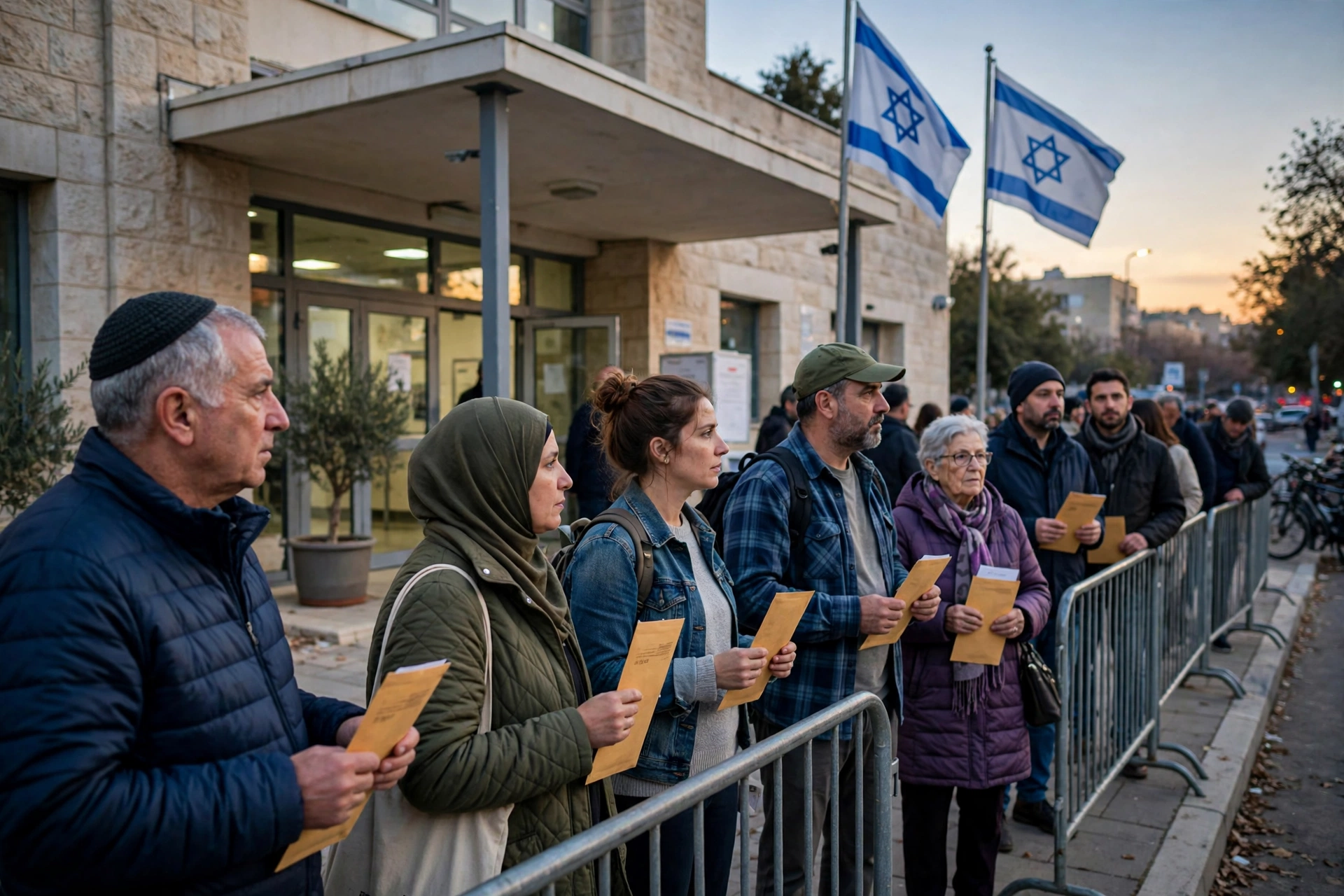
Turnout was the highest in more than a quarter of a century, as voters delivered their verdict on Mr Netanyahu, Israel’s longest-serving prime minister, analysts said.
A historic showing for Arab parties
The most striking feature of the count has been the surge of Arab-led parties, projected to win 19 seats — an unprecedented total that could make them kingmakers, even though many opposition parties have ruled out sitting in government with them.
On paper, Mr Eisenkot’s bloc would reach a majority only with Arab backing, whether inside a coalition or through a so-called safety-net arrangement in which they support a government from outside without joining it. Whether that arithmetic can become a working government is far from certain.
Yair Golan, leader of the Democrats party, urged the opposition to join hands with Arab-led parties to replace Mr Netanyahu, while Joint List chief Yousef Jabareen said his party was ready to help oust him. Mr Netanyahu, by contrast, has dismissed partnering with Arab parties, whose constituents make up about a fifth of Israel’s population.
Both leaders claim the mandate
Addressing supporters at Likud headquarters in Jerusalem in the early hours of Wednesday, Mr Netanyahu called for the formation of what he termed a strong, right-wing national government. He pointed to Israel’s military successes and raised the prospect of renewed joint action against Iran alongside his ally, United States President Donald Trump.
Mr Eisenkot acknowledged Mr Netanyahu remains caretaker prime minister but said he had lost public support and urged him to retire from politics.
What happens next
The counting of about 500,000 ballots cast by soldiers and other voters away from their registered polling stations was due to begin at midnight, with full results expected by October 29 or 30. Even then, the outcome may not settle who governs: Mr Netanyahu would remain as caretaker prime minister during coalition negotiations, or until a new election in 2027 if talks fail, analysts said.
For the wider Middle East, the result prolongs uncertainty over the next phase of the Gaza ceasefire, relations with Arab states, and any future confrontation with Iran.