

ADEN — October 5, 2026. Yemen’s Saudi-backed, internationally recognized government on Sunday launched a major military campaign to recapture all areas of the country controlled by the Iran-aligned Houthis, including the capital Sanaa after more than a decade of rebel rule.
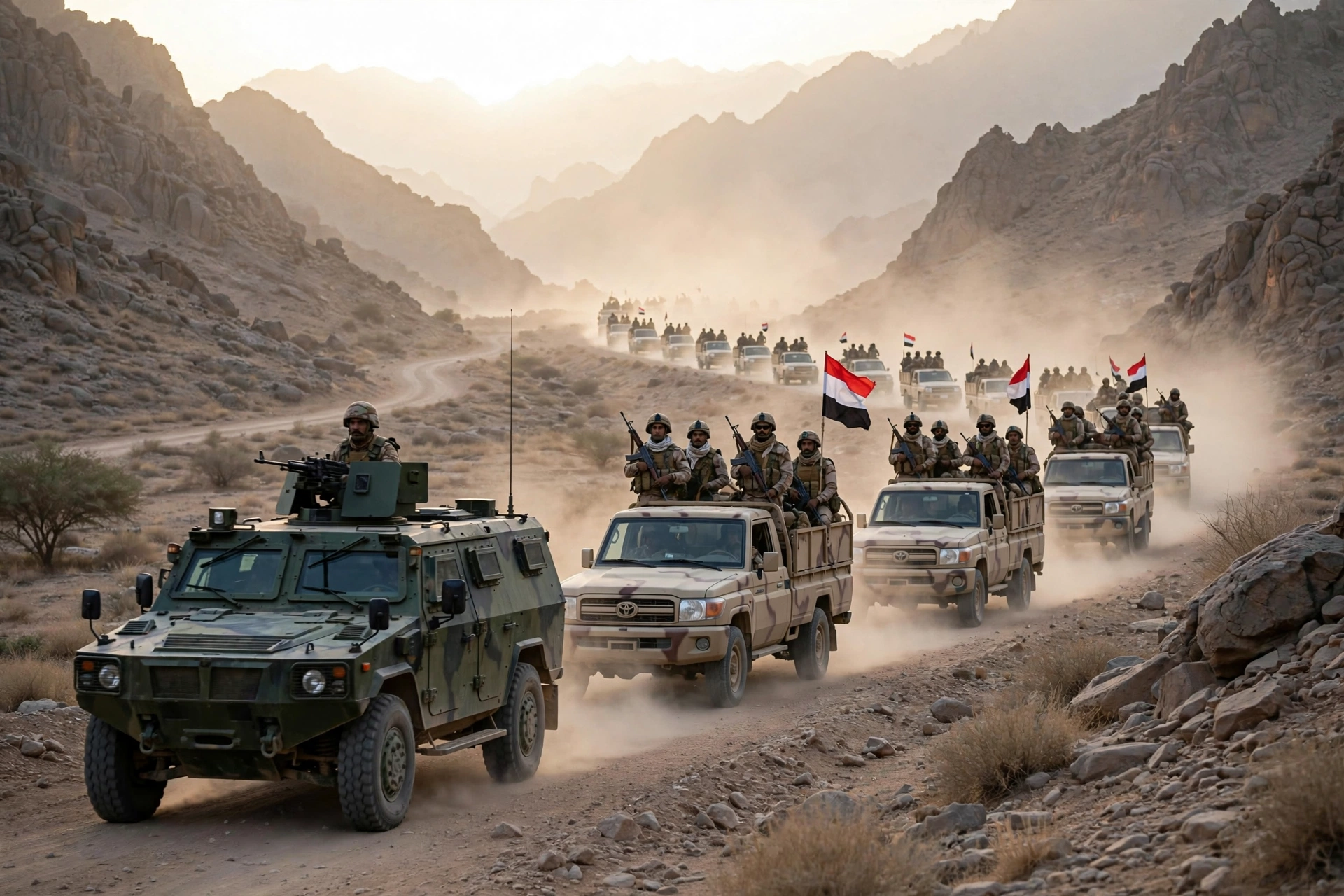
President Rashad al-Alimi announced the start of the offensive in a televised address from Aden, declaring: “Today, I announce the start of military operations to retake the remaining territory of the republic and extend the authority of the state and its institutions across the entire national territory.”
“Today we are embarking on a decisive phase in the history of our nation,” al-Alimi said, adding that the government had made “great sacrifices” in choosing the path of peace.
Coalition pledges full operational support
The Saudi-led coalition pledged “full operational support” for the offensive, state media reported, raising the prospect of the heaviest air campaign in years. The announcement came amid an intensified exchange of fire across the border.
The Houthis claimed Saudi Arabia carried out 106 air and missile strikes on Sanaa and other areas over the past 24 hours, according to the movement’s statements. In parallel, the Houthis claimed their own ballistic-missile and drone strikes on Saudi Aramco sites in Riyadh and the Khurais area, which they said caused major fires. Saudi Arabia did not immediately confirm either claim.
A military spokesman for the Yemeni armed forces, Colonel Majid Al-Nuzaili, said government forces would press the offensive “until the country is liberated from the grip of the terrorist militia,” and called on Houthi fighters to lay down their weapons. He said the operations aimed to relieve the “suffering of the Yemeni people” and ensure “no authority prevails except the constitution and the rule of law.”
A war more than a decade in the making
The Houthis, formally known as Ansar Allah, have held Sanaa and vast parts of Yemen’s northwest, where most of the population lives, since 2014. They have withstood a series of offensives over the years by Saudi Arabia, the UAE and their Western allies, and have upgraded their weaponry with help from Iran, according to Western and regional officials.
The offensive follows a Houthi surprise advance last month that captured the strategic Bab el-Mandeb strait and some 150 kilometers of Red Sea coastline in a matter of weeks, trade sources said, giving the movement new leverage over one of the world’s busiest shipping lanes.
That advance opened a new front in the wider US-Israeli war against Iran that began in February, to which Tehran has responded by choking oil shipments through the Strait of Hormuz, analysts said.
What comes next
Al-Alimi told residents in Houthi-controlled areas to stay away from militant gathering places and protect their children from being drawn into the fighting. “The military operations we are about to launch are not a war against our people in Sanaa, Hodeidah, and Sa’ada,” he said. “They are not a war against any sect or tribe.”
He said every city reclaimed by the state would enter a phase of stability, recovery and reconstruction, and that the success of the battle would be measured by how many citizens regained a sense of security.
The president closed by calling on the international community to stand by Yemen and expressed gratitude to Saudi Arabia’s leadership, describing the kingdom as “a true partner in our shared destiny and security.”