

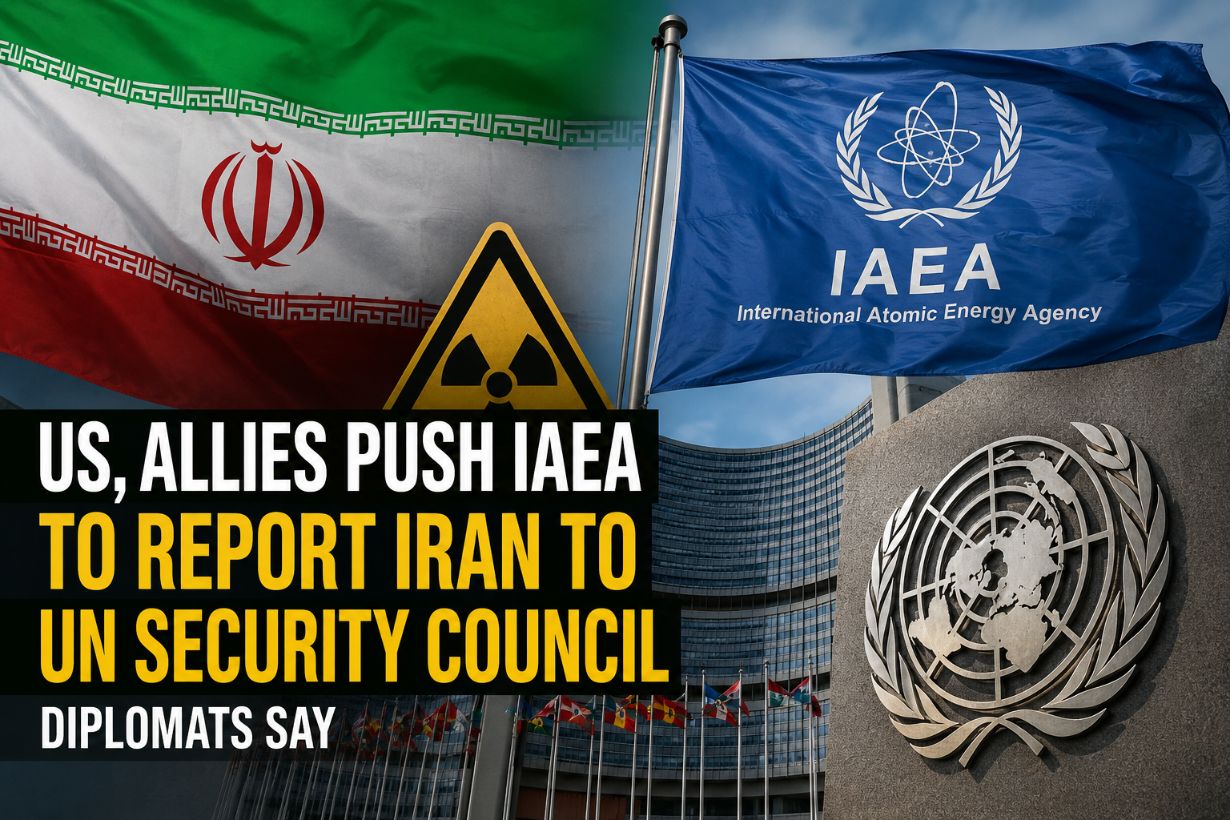
VIENNA — September 4, 2026: The United States and its European allies are pushing for the International Atomic Energy Agency (IAEA) Board of Governors to take a tougher stance against Iran and report the country’s nuclear file to the United Nations Security Council, according to diplomats familiar with the discussions.
The United States, Britain, France and Germany are seeking support for a resolution expected to be considered at the IAEA Board’s upcoming meeting. If approved, the move would mark a significant escalation in international pressure on Tehran over concerns surrounding its nuclear activities and the agency’s ability to verify Iran’s nuclear material.
Why Is the IAEA Concerned About Iran?
The dispute centers largely on the IAEA’s difficulty in obtaining sufficient information and access to Iranian nuclear facilities.
The nuclear watchdog has said that restrictions on inspections have prevented it from fully verifying the status of Iran’s nuclear material. Particular concern has focused on highly enriched uranium whose current location and condition cannot be independently verified by the agency.
In a statement earlier this year, Britain, France, Germany and the United States said Iran had failed to provide information requested by the IAEA concerning affected nuclear facilities and nuclear material. They argued that this has limited the agency’s ability to carry out its safeguards responsibilities.
US and European Allies Seek a New Resolution
Washington and its European partners are now working to persuade other members of the IAEA Board to support a new resolution.
Diplomats said the draft text is still being negotiated and could change before it is formally presented. The objective, however, is to increase pressure on Iran by bringing the matter before the UN Security Council.
The initiative comes after the IAEA previously found Iran in violation of its non-proliferation obligations because of its lack of cooperation over questions concerning undeclared nuclear material and facilities.
Iran’s Nuclear Program Under Growing International Pressure
Iran has repeatedly maintained that its nuclear program is intended for peaceful purposes. Tehran has also criticized international pressure and argued that its nuclear rights should be respected.
However, Iran’s uranium enrichment activities have become a major source of concern for Western governments.
Iran has previously accumulated uranium enriched to 60 percent purity. While this is below the level generally associated with weapons-grade material, it is significantly above the enrichment level normally required for civilian nuclear power and has therefore drawn international scrutiny.
Access to Nuclear Sites Remains a Key Issue
One of the most important issues in the dispute is the IAEA’s ability to inspect Iran’s nuclear facilities.
The agency has warned that the lack of access and information makes it difficult to establish a complete picture of Iran’s nuclear activities. In its latest reporting, the IAEA described the inability to verify nuclear material and access relevant facilities as a serious proliferation concern.
Iran, meanwhile, has restricted access to some facilities affected by military attacks and has challenged the framework under which inspections should take place.
What Would Reporting Iran to the UN Security Council Mean?
A decision by the IAEA Board to report Iran to the UN Security Council would represent a major diplomatic development.
The Security Council is the UN body responsible for addressing threats to international peace and security. Bringing Iran’s nuclear case before it could open the door to further diplomatic measures and potentially additional international pressure.
However, such a move would not automatically mean that new sanctions or military action would follow. The consequences would depend on subsequent decisions by the Security Council and the positions of its members.
Risk of Further Regional Escalation
The latest diplomatic push comes at a particularly sensitive time for the Middle East.
Tensions between Iran and Western countries have remained high, while disagreements over Iran’s nuclear program continue alongside wider regional security disputes.
The United States and its allies argue that stronger international monitoring is necessary to prevent Iran’s nuclear activities from moving beyond peaceful purposes. Tehran insists that its program is peaceful and has objected to what it considers excessive international pressure.
The latest IAEA initiative could therefore become another major test for diplomacy between Iran and Western governments.
What Happens Next?
The IAEA Board of Governors is expected to consider the proposed resolution at its upcoming meeting.
Diplomats said negotiations over the wording are continuing, meaning the final text could differ from the current draft.
The outcome will depend partly on whether the United States, Britain, France and Germany can secure enough support among the IAEA’s member states.
For Iran, a referral to the UN Security Council would increase diplomatic pressure at a time when questions over its nuclear material and access for international inspectors remain unresolved.
For the international community, the central challenge will be finding a way to restore effective nuclear monitoring while avoiding another major escalation in an already tense region.
The coming IAEA meeting could therefore prove crucial for the future of Iran’s nuclear diplomacy and the wider security landscape of the Middle East.